
Entry 15: Wood Spirit Bone Fury (Mộc Tinh Xương Cuồng)
In Vietnamese legend, the Wood Spirit Bone Fury is an ancient monster born from the giant Agarwood tree, transforming into a handsome man who seduces the populace and then slaughters and devours them, only destroyed after three battles with the founding kings.
Cost: 4
|Health: 10
|Power: 7
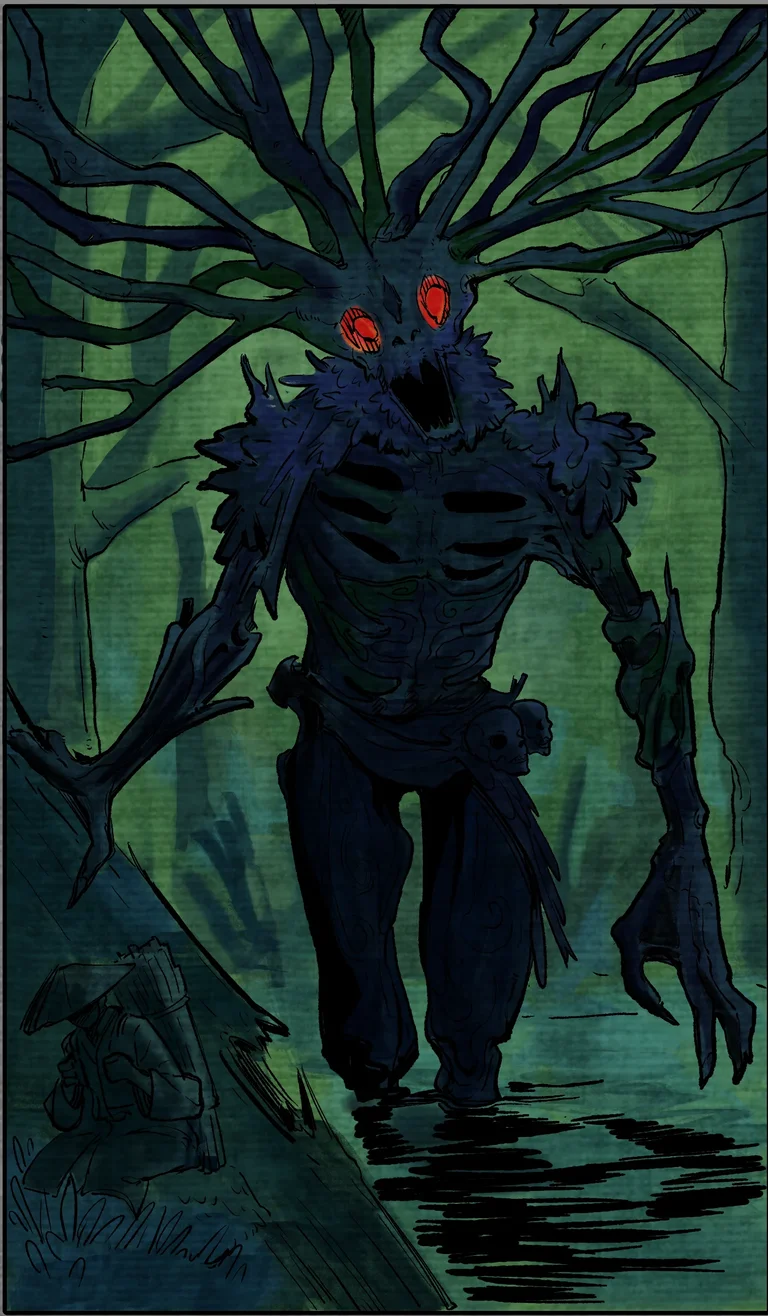
Origin from the Spirit of the Ancient Tree
Bone Fury is not merely a name, but a curse of undying rage, born from the colossal Agarwood tree in ancient Bach Hac, now part of Tam Giang. That tree soared thousands of feet into the sky, its canopy blanketing hundreds of miles, drawing in the spiritual essence of heaven and earth across countless millennia before it withered and birthed an evil heart. From the rotting wooden trunk, the Wood Spirit rose like a specter from the forest’s depths, poised to swallow everything in its path to sate an eternal hunger.
The people of antiquity, quaking before such power, twisted their horror into worship, erecting temples and naming it the Bone Fury God. They were compelled to offer living human sacrifices, often seized from the Lao Zi barbarians of Ba Lo, now Dien Chau in Nghe An, precisely on the night of the thirtieth day of the twelfth lunar month. Yet that ritual brought no solace to the beast; instead, it only fed its growth, transforming the once-fertile land into a realm choked with soaring怨气.
Seductive Form Hiding Malevolence
The Wood Spirit possesses a cunning so profound it borders on terror, masking its fiendish essence beneath the guise of a strikingly handsome man, with hair blazing red like the flames of hell and skin as pallid as dawn’s mist. A bizarre, intoxicating fragrance emanates from its arboreal form, ensnaring lost travelers in a fatal embrace where a soft smile swiftly morphs into razor-sharp fangs. It preys first on women and children, draining their vital energies to amplify its might, abandoning their desiccated husks beneath the verdant foliage.
Even when unmasked, it slinks back into the shadows, murmuring through the rustling winds that its fury has never truly slumbered. Nham Ngao himself, the bold magistrate under Qin Shi Huang who defied the sacrificial rites, met his end throttled in the gloom by its grasp, deepening the people’s cowering dread. Bone Fury’s very being serves as a chilling reminder: beauty can veil the abyss with but a fragile layer.
The First Clash with Kinh Duong Wang
Kinh Duong Wang, the sovereign who parted the heavens and founded the land, first encountered the Wood Spirit as it ravaged Phong Chau, scattering death across the realm. Rather than charge into reckless combat, he wielded cunning, forging celestial music from stone and bronze while commanding his subjects to kindle fires and revel in song and dance through endless days and nights. Drawn by curiosity, the fiend crept near, ensnared by the trap, and was felled by a bolt of heavenly lightning that left it gravely wounded, forcing a fleeting retreat into hiding.
Subdued for a moment, Bone Fury’s core remained unaltered; the injury was merely a brief repose before fresh tempests of wrath. Whispers in folklore claim that melody still haunts the gales, yet the creature has since mastered evasion, biding its time for unguarded instants to resurface. This marked the initial revelation of ancient shadow’s unyielding tenacity.
The Second Encounter: Lac Long Quan and the Shattered Seal
Lac Long Quan, the dragon rising from oceanic abysses, endured repeated rituals to quell the Wood Spirit after its resurgence unleashed further woe. At last, he invoked the sacred Dragon Pearl to bind the abomination within the Agarwood’s roots, then ignited it with divine flames. Those fires blazed relentlessly for months, reducing the woodland to a vast, smoldering pyre of embers, but the tree’s immense girth betrayed a fatal flaw, allowing Bone Fury to shatter its bonds.
It fled southwestward, seeking sanctuary in an ancient tree of Dien Chau, where it proclaimed itself the Bone Fury God and resumed its demands for tribute. Lac Long Quan gazed heavenward in sorrow, foretelling that only upon Nam’s liberation from northern chains would a true vanquisher arise. That malediction lingered like drifting smoke and embers, awaiting history’s pivotal dawn.
The Ultimate Confrontation Under Dinh Tien Hoang
Eons later, as Dinh Bo Linh forged unity across the land and severed the bonds of northern dominion, the prophecy unfurled into reality. The northern sorcerer Van Du Tuong arrived, scheming to enlist six acrobatic performers in erecting the Phi Van Tower, towering twenty meters high, alive with clamorous cymbals and thundering drums in spectacles of mirth. Bone Fury and its haughty thralls ventured forth to spectate, their wariness dissolved amid peals of laughter and swirling dances, granting the mage the moment to intone forbidden incantations and cleave its essence with a decisive sword stroke at the core.
The fiend and its minions dissolved into oblivion, denied any rebirth, and the barbaric rite of living offerings ceased forevermore. Dien Chau’s soil slowly reclaimed serenity, though echoes of怨气 stir yet in the shrieking winds of night. Herein lay triumph born of intellect and artistry, affirming humanity’s capacity to tame even primordial phantoms.
The White Tiger Variant and Enduring Legacy of Hatred
In the aftermath of Lac Long Quan’s inferno, a fragment of the Wood Spirit’s ethereal awareness endured, morphing into a bellowing Tiger Essence that dubbed itself the White Tiger Bone Fury, aligning with lore viewing tigers as embodiments of the forest’s mightiest elder trees. This metamorphosis wove into sacred traditions, reshaping veneration of Bone Fury into rituals for Ông Ba Mươi on the thirtieth of the twelfth lunar month, shunning the Tiger’s hour. Majestic as it appears, this form retains traces of savagery, evoking the insatiable rage that once engulfed myriad souls.
Within Vietnam’s tapestry of folklore, Bone Fury ranks among the mightiest abominations, a gauntlet spanning eras from Kinh Duong to Dinh Tien Hoang. It embodies nature’s ravaging force entwined with profane obsessions, subdued solely by mortal guile. Even now, Nghe An’s woodlands murmur these tales in hushed tones, cautioning that obscurity may reclaim its throne should recollection dim.